
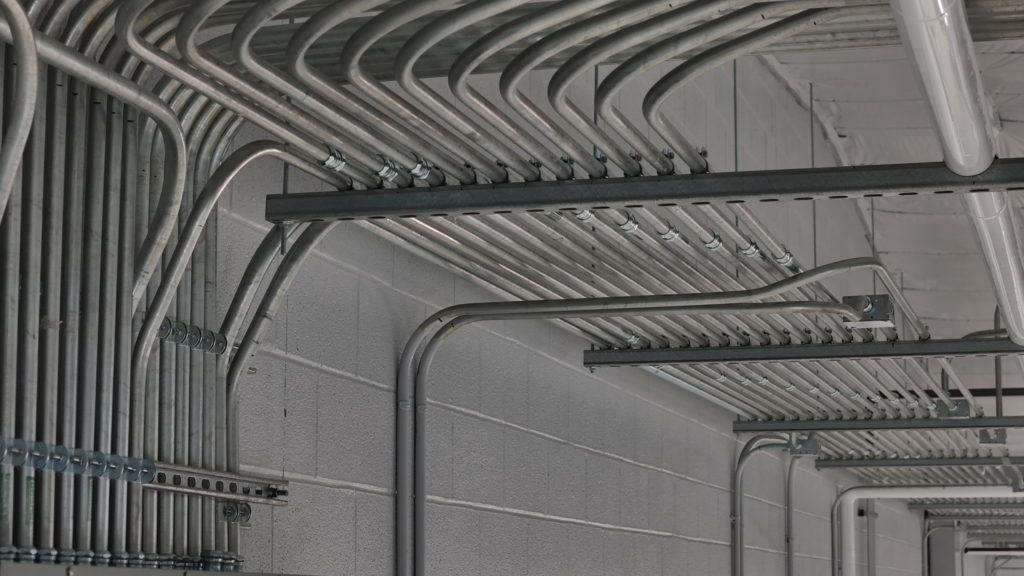
Industrial electrical wiring is the backbone of every plant floor, warehouse, and production line in Duncansville, PA. It is also the part of a facility most people never see until something stops working. When a feeder fails or a motor circuit trips at the wrong moment, the cost is measured in lost production, not just repair bills. This guide explains what industrial electrical wiring involves, why it is held to a stricter standard than home or office wiring, what the code requires in Blair County, and how to choose a contractor who can keep your operation running. Adams Electric has wired industrial buildings across Central Pennsylvania since 1919, so the examples here come from real work, not theory.
Key Takeaways
- Industrial wiring carries heavier loads, higher voltages, and harsher conditions than commercial or residential work, so it demands different materials and methods.
- In Pennsylvania, industrial electrical work is regulated statewide through the Uniform Construction Code, which means permits and inspection for most projects.
- Electrical hazards cause well over 100 worker deaths a year nationally, which is why permitting, inspection, and maintenance are not optional.
- A qualified industrial contractor handles power distribution, machine and equipment wiring, generators, and code corrections under one roof.
- In Duncansville, look for a licensed, insured, and experienced local contractor. Adams Electric has served Blair County since 1919.
What is industrial electrical wiring, and how does it differ from commercial work?
The industrial sector used about 1.04 trillion kilowatt-hours of electricity in 2025, roughly 25.7 percent of all U.S. retail electricity sales, according to the U.S. Energy Information Administration. Industrial electrical wiring is the system of feeders, branch circuits, conduit, controls, and grounding that delivers power to machinery, process equipment, and heavy loads inside a manufacturing or production facility. It differs from commercial and residential wiring in three ways that matter on the job.
First, the loads are larger. A plant may run three-phase 480-volt equipment, large motors, welders, compressors, and heating systems that a home circuit could never support. Second, the environment is harsher. Wiring has to survive dust, moisture, vibration, chemicals, and temperature swings, so conduit, cable types, and enclosure ratings are chosen for the exact conditions of each area. Third, uptime is the whole point. An industrial system is designed so a single fault can be isolated and repaired without shutting down the entire building.
By the numbers
Industrial wiring is a different scale of system
Plant loads, plant risk, and the trade that handles them — the figures behind why industrial work is held to a stricter standard than commercial or residential wiring.
25.7%
of all U.S. retail electricity sales went to the industrial sector in 2025 — about 1.04 trillion kilowatt-hours
130
fatal U.S. work injuries from exposure to electricity in 2024, after 142 the year before
+9%
projected growth in electrician employment 2025–2035, with about 72,700 openings a year
That is why industrial work leans on things you rarely see in a house: motor control centers, bus duct, hard conduit runs, dedicated equipment grounds, and clearly labeled disconnects. At Adams Electric, our commercial and industrial electrical services cover equipment wiring, power distribution, machinery maintenance, and industrial generator installation for facilities of any size.
How dangerous is faulty industrial wiring?
Exposure to electricity caused 130 fatal work injuries in the United States in 2024, and 142 in 2023, according to the U.S. Bureau of Labor Statistics. Industrial spaces concentrate that risk. High current, heavy equipment, and continuous operation mean that a loose connection, an overloaded circuit, or aging insulation can start a fire or injure a worker before anyone notices a problem.
The failure modes are predictable, which is good news for prevention. Overloaded feeders overheat. Undersized conductors run hot inside conduit. Corroded terminations increase resistance and build heat at the connection. Missing or damaged grounding leaves equipment frames energized. Regular inspection, thermal scanning, and correcting code violations early are the practical defenses. When our electricians service an older plant, identifying and correcting code violations is one of the first things we do, because small defects compound over years of hard use.
What codes govern industrial electrical wiring in Duncansville, PA?
In Pennsylvania, electrical work is regulated statewide through the Uniform Construction Code, administered by the Pennsylvania Department of Labor and Industry. That framework sets the baseline for how industrial electrical work is permitted, inspected, and approved.
The Uniform Construction Code applies across the Commonwealth and is enforced locally, so a facility in Duncansville or Hollidaysburg follows the same core electrical rules as the rest of Pennsylvania. It adopts the widely used national building and electrical standards, including the National Electrical Code that the industry references for sizing conductors, protecting circuits, and grounding equipment. In practice, that means permits and inspections for most industrial electrical work. A contractor who pulls the correct permit, wires to code, and passes inspection is protecting your insurance coverage as much as your people. You can see how we document completed work on our projects page.
What industrial electrical wiring services does a Duncansville facility need?
After more than a century wiring plants and shops across Blair County, we see the same needs repeat on almost every industrial project. Most industrial facilities need the same core set of electrical services, whether they are building new, expanding, or maintaining what they already run. Grouping the work by function makes it easier to plan a budget and a schedule.
- Power distribution: service entrances, panels, switchgear, feeders, and branch circuits sized for present and future loads.
- Equipment and machine wiring: connecting production machinery, controls, and process equipment safely and to spec.
- Generator installation: standby and backup power so a utility outage does not stop production.
- Lighting and exterior electric: high-bay lighting, parking lot and security lighting, and occupancy controls.
- Maintenance and repairs: troubleshooting, thermal inspection, and correcting code violations before they become failures.
These are the services Adams Electric performs every week for commercial and industrial clients around Altoona, Hollidaysburg, and Duncansville. Because we handle installation, upgrades, and repairs under one roof, a facility manager can plan a project with one accountable contractor instead of coordinating several trades.
How do you choose an industrial electrical contractor in Duncansville, PA?
Employment of electricians is projected to grow 9 percent from 2025 to 2035, much faster than the average for all jobs, with about 72,700 openings each year, according to the U.S. Bureau of Labor Statistics. Skilled industrial electricians are in steady demand, so the best contractors book up. Choosing well early is easier than fixing a rushed job later. A few questions separate a qualified industrial contractor from a general electrician.
Are they licensed and insured for industrial work? Do they have real experience with three-phase power, motor circuits, and the equipment your process uses? Can they pull permits and pass inspection under the Pennsylvania Uniform Construction Code? Will they document the work so your maintenance team and inspectors can follow it later? Do they respond quickly when a line goes down? Local matters here, because a contractor based in Blair County can reach your plant fast when production is stopped.
Adams Electric checks each of those boxes. We are a licensed and insured, family-owned company that has served Central Pennsylvania since 1919, and industrial work has been part of that history for generations. You can read more about our story on our About Us page, or request an estimate to talk through a specific project.
Frequently Asked Questions
Do I need a permit for industrial electrical wiring in Duncansville, PA?
Most industrial electrical work requires a permit and inspection under Pennsylvania’s statewide Uniform Construction Code. A licensed contractor handles the permit and schedules the inspection as part of the job. Skipping it can void insurance coverage and create liability if a fault later causes damage.
What voltage is used for industrial electrical wiring?
Industrial facilities commonly use three-phase power, often 480 volts for larger motors and equipment, stepped down to 208 or 120 volts for lighting, receptacles, and controls. The exact configuration depends on the utility service, the equipment on site, and future expansion plans. A contractor sizes the service and feeders around your real and projected loads.
How often should industrial electrical systems be inspected?
Beyond the inspection required at installation, most facilities benefit from an annual electrical inspection plus thermal scanning of panels and connections. Heavy or continuous operations may warrant more frequent checks. Regular inspection catches overheating terminations and overloaded circuits before they cause downtime or fire.
Does Adams Electric serve Duncansville and the surrounding area?
Yes. Adams Electric is based in Altoona and works as an electrician in Duncansville, Hollidaysburg, and the wider Blair County and Central Pennsylvania region. The company has provided residential, commercial, and industrial electrical services since 1919. Call (814) 944-4621 or use the contact page to request an estimate.
Talk to a local industrial electrician
Industrial electrical wiring rewards experience and punishes shortcuts. If you run a facility in or near Duncansville, PA and want wiring that is safe, code-compliant, and built to keep production moving, work with a contractor who has done it for over a century. Reach Adams Electric at (814) 944-4621, or contact us to request an estimate.
About Adams Electric. Adams Electric is a family-owned electrical contractor serving Central Pennsylvania since 1919, including Altoona, Hollidaysburg, and Duncansville. Licensed and insured. 870 31st St, Altoona, PA 16601. Phone: (814) 944-4621.